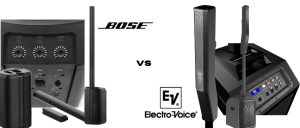
I’ve been using the Bose L1 since 2007, long before the competition existed. Since then I’ve watched every major manufacturer release their own column array version. EV Evolve, QSC, LD Systems, RCF, Mackie, and more — I’ve heard some, not all, I’ve read or watched trusted industry leaders review the rest, and not one mentions the things that Bose stands apart for – because the others don’t have it.
Here’s my honest take.
I bought my first Bose L1 sight unseen. Never heard one. Never saw one in person. My mate Richard — who went on to co-found what became Rich Audio before he passed away in 2020 — talked me into it. That was sometime around 2007. Between us, we were two of the first DJs in New Zealand to own one.
Since then I’ve owned or used every model in the L1 range — the original Model 1, the Compact, the Model II, the 1s, and now the Pro8, Pro16, and Pro32. I’ve watched every major manufacturer release their own version of the same concept. QSC, EV, LD Systems, Mackie — they’ve all had a crack at it.
None of them got it quite right. Here’s why.
Bose Invented This Category — At Least For Working Performers
The column array speaker wasn’t a new concept when Bose released the original L1 in 2003. Line arrays had existed in large-scale touring and installation for years. What Bose did was bring the concept down to a size and price point that a solo musician or working DJ could actually own and use.
That matters because it means Bose had a 10-15 year head start before the serious competitors arrived. They didn’t just design a product — they spent years understanding exactly how a working performer uses a PA system, what they need from it, and what they don’t. That accumulated knowledge shows in ways that are hard to put on a spec sheet.
Bose L1 vs EV Evolve, QSC, LD Systems, RCF, Mackie and more
Electro-Voice (EV) Evolve 50 and Evolve 50M
The EV Evolve is the most direct competitor to the Bose L1 Pro range and the one I get asked about most often. On paper it’s impressive — the Evolve 50M in particular has specs that match or beat the Pro16. The app is arguably more reliable and feature-rich than the Bose L1 Mix app.
I’ve heard the EV Evolve at events. I wasn’t impressed. The specific thing it lacks is warmth — voices and music have a harder, thinner quality compared to the Bose. It gets loud and it covers a room, but the character of the sound isn’t the same. After years of listening to the L1, the difference is immediately obvious to me. Whether it’s obvious to your audience is harder to say — but I know which one I’d rather have representing me at a wedding.
The dispersion is also narrower than the Bose. The L1’s near 180-degree horizontal coverage means you can place it at the corner or short end of a room and cover almost the entire space evenly. The Evolve delivers a tighter, more focused column. For some applications that’s fine — but for the way most DJs and performers actually use a PA at events, the Bose coverage pattern is more forgiving.
QSC
I’m honestly not certain I’ve heard a QSC column array in isolation at an event. Which probably tells you something — forgettable isn’t a quality you want in a PA system. QSC makes solid, well-regarded products and their powered cabinet range is respected. But they haven’t made a strong impression on me in the column array space, and I haven’t had enough DJs or performers ask me “what do you think of QSC vs Bose” to suggest it’s a serious contender in the NZ market at this level.
LD Systems Maui Series
The LD Systems Maui range is probably the closest visual clone of the Bose L1 concept. Tall column, integrated sub base, similar setup procedure. The pricing is generally lower than Bose which makes it attractive on paper.
I haven’t personally heard the Maui in a real event situation, so I won’t pretend to compare the sound. What I do know is that it’s heavy — noticeably heavier than the L1 Pro range — which matters a lot when you’re loading in and out of venues solo. One of the L1’s genuine advantages is that it’s light enough to be a one-person job. If you’re considering the Maui on price, factor in whether you’re also okay with the extra weight every single gig.
Mackie
Mackie’s column array offerings are competent workhorses. Good value, reliable, widely supported. For someone who needs a PA and doesn’t want to spend Bose money, Mackie is a reasonable choice. But “reasonable” is the ceiling — they don’t have the design refinement or the sound character of the L1.
The Thing Nobody Talks About — The Room Recognition Factor
Here’s something none of the spec sheets mention. When you show up to a wedding or corporate event with a Bose L1, guests who know nothing about audio equipment will walk up and say “oh, is that Bose?” They recognise it. They associate it with quality before you’ve played a single note.
That doesn’t happen with an EV Evolve. It doesn’t happen with an LD Systems Maui. It definitely doesn’t happen with a Mackie.
For a working DJ or performer, this matters more than it should. Client perception is part of the job. Showing up with gear that the room recognises as premium is a small but real advantage, and it’s one Bose has built over 20 years that none of the competitors have been able to replicate.
So Is the Bose L1 Still the Right Choice in 2026?
For most working DJs and performers doing weddings, corporate events, and mid-sized venues in New Zealand — yes. The combination of sound quality, coverage pattern, portability, and brand recognition is still the best package available at this level.
The competitors have closed the gap on specs. Some have better apps. Some are cheaper. None of them have managed to replicate the specific character of what the L1 does in a real room with real people in it.
I’ve been using this gear at real events since 2007. I stock it because I believe in it, not the other way around.