Bose L1 Pro8 vs Pro16 — Which One Do You Actually Need?

Bose L1 Pro8 vs Pro16 — Which One Do You Actually Need?

I use both the Bose L1 Pro8 and Pro16 at real events as a wedding MC and corporate event DJ. Here’s my honest comparison of the two — not from a spec sheet, but from years of actually running them at weddings, corporate events, and everything in between.


Bose L1 Pro8 vs Pro16 — The Quick Answer

If you’re in a hurry: the Pro8 is for smaller events and secondary speaker roles, the Pro16 is for performers who want one system that handles most situations on its own. But the longer answer is more interesting than that, and knowing the difference properly will save you from buying the wrong one.

The L1 Pro8 — Don’t Underestimate It

The Pro8 gets underestimated constantly because of its size. That’s a mistake.

I use the Pro8 as my sole speaker at most of my events with 100 guests or less. It handles those rooms comfortably — the bottom end is surprisingly strong for a system this compact, and the 180-degree dispersion means coverage from a single Pro8 is even without repositioning. For a DJ or musician running a smaller wedding or corporate function, one Pro8 is genuinely enough.

Where the Pro8 really earns its place in my setup is as a remote speaker. I run it wirelessly from my DJ mixer’s zone output — either via Sennheiser G3 wireless packs or SKAA wireless from Dillinger Labs — which lets me adjust the remote speaker volume independently from the main system. That’s useful for odd-shaped venues, second rooms, or situations where sound needs to reach around a corner without cranking the main system.

The Pro8 is also the lightest and most portable system in the L1 Pro range. If you’re doing solo acoustic gigs, presentations, or ceremony audio where you’re setting up alone and pack-in time matters, nothing else in this range touches it for convenience.

Pro8 Specs

  • Output: 112dB continuous, 118dB peak
  • Power: 60W array, 240W subwoofer
  • Low frequency: 45Hz
  • Weight: 18kg
  • Mixer channels: 3

The L1 Pro16 — One System That Does Most Things

The Pro16 is where most working DJs and performers land, and for good reason. It’s significantly more powerful than the Pro8, covers larger rooms comfortably, and the built-in subwoofer (same size as the Sub2) handles bass-heavy music in a way the Pro8 can’t match at volume.

I know solo musicians and plenty of DJs who rely on a single Pro16 with no additional sub, no extra gear. For mid-sized venues — a wedding reception of 100-200 guests, a corporate event in a function room, a bar gig — one Pro16 can do the job. That’s not me selling you something bigger than you need. It’s the reality of what this system is capable of.

The Pro16 is also the system I’d recommend if you’re buying once and don’t want to think about it again. It has enough headroom that you’ll rarely push it to its limits in normal gigging situations, and the wide dispersion means you’re not fighting coverage problems in awkward rooms.

Pro16 Specs

  • Output: 118dB continuous, 124dB peak
  • Power: 250W array, 1000W subwoofer
  • Low frequency: 42Hz
  • Weight: 24.9kg
  • Mixer channels: 3

Key Differences Side by Side

Pro8Pro16
Max output118dB peak124dB peak
Weight18kg24.9kg
Best forUp to ~100 guests, remote speaker useUp to ~200 guests as standalone
PortabilityMost portable in the rangeHeavier but still one-person setup, easier with the optional Rollerbag
Add a sub?Optional but useful for DJ useOften not needed

Which One Should You Buy?

Buy the Pro8 if: you’re doing smaller events (under 100 guests), you need a lightweight portable system, you want a secondary speaker to pair with a larger system, or you’re a solo acoustic performer who values portability over raw output.

Buy the Pro16 if: you want one system that handles most gigging situations without needing additional gear, you’re regularly doing events of 100-200 guests, or you’re a DJ who wants genuine headroom without adding a separate subwoofer.

Buy both if: you’re a working DJ doing varied events. The Pro8 as a remote or ceremony speaker paired with a Pro16 or Pro32 as your main system covers almost every situation you’ll encounter.

Not sure? Contact me and describe your typical gig. I’ll tell you what I’d use in your situation and get you the best possible pricing in New Zealand.  If you’re in Auckland,we can even arrage a demo at your event!

Buy the Bose L1 Pro8 or Pro16 in New Zealand

Authorised NZ dealer. I use both at real events — ask me which one suits your situation.
Shop the Pro8 →
Shop the Pro16 →
Ask Nick

Bose L1 vs EV Evolve vs QSC vs LD Systems — Why Nobody Has Beaten the Original

I’ve been using the Bose L1 since 2007, long before the competition existed. Since then I’ve watched every major manufacturer release their own column array version. EV Evolve, QSC, LD Systems, RCF, Mackie, and more — I’ve heard some, not all, I’ve read or watched trusted industry leaders review the rest, and not one mentions the things that Bose stands apart for – because the others don’t have it.

Here’s my honest take.

I bought my first Bose L1 sight unseen. Never heard one. Never saw one in person. My mate Richard — who went on to co-found what became Rich Audio before he passed away in 2020 — talked me into it. That was sometime around 2007. Between us, we were two of the first DJs in New Zealand to own one.

Since then I’ve owned or used every model in the L1 range — the original Model 1, the Compact, the Model II, the 1s, and now the Pro8, Pro16, and Pro32. I’ve watched every major manufacturer release their own version of the same concept. QSC, EV, LD Systems, Mackie — they’ve all had a crack at it.

None of them got it quite right. Here’s why.

Bose Invented This Category — At Least For Working Performers

The column array speaker wasn’t a new concept when Bose released the original L1 in 2003. Line arrays had existed in large-scale touring and installation for years. What Bose did was bring the concept down to a size and price point that a solo musician or working DJ could actually own and use.

That matters because it means Bose had a 10-15 year head start before the serious competitors arrived. They didn’t just design a product — they spent years understanding exactly how a working performer uses a PA system, what they need from it, and what they don’t. That accumulated knowledge shows in ways that are hard to put on a spec sheet.

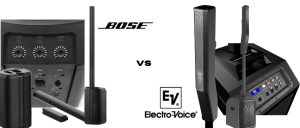
Bose L1 vs EV Evolve, QSC, LD Systems, RCF, Mackie and more

Electro-Voice (EV) Evolve 50 and Evolve 50M

The EV Evolve is the most direct competitor to the Bose L1 Pro range and the one I get asked about most often. On paper it’s impressive — the Evolve 50M in particular has specs that match or beat the Pro16. The app is arguably more reliable and feature-rich than the Bose L1 Mix app.

I’ve heard the EV Evolve at events. I wasn’t impressed. The specific thing it lacks is warmth — voices and music have a harder, thinner quality compared to the Bose. It gets loud and it covers a room, but the character of the sound isn’t the same. After years of listening to the L1, the difference is immediately obvious to me. Whether it’s obvious to your audience is harder to say — but I know which one I’d rather have representing me at a wedding.

The dispersion is also narrower than the Bose. The L1’s near 180-degree horizontal coverage means you can place it at the corner or short end of a room and cover almost the entire space evenly. The Evolve delivers a tighter, more focused column. For some applications that’s fine — but for the way most DJs and performers actually use a PA at events, the Bose coverage pattern is more forgiving.

QSC

I’m honestly not certain I’ve heard a QSC column array in isolation at an event. Which probably tells you something — forgettable isn’t a quality you want in a PA system. QSC makes solid, well-regarded products and their powered cabinet range is respected. But they haven’t made a strong impression on me in the column array space, and I haven’t had enough DJs or performers ask me “what do you think of QSC vs Bose” to suggest it’s a serious contender in the NZ market at this level.

LD Systems Maui Series

The LD Systems Maui range is probably the closest visual clone of the Bose L1 concept. Tall column, integrated sub base, similar setup procedure. The pricing is generally lower than Bose which makes it attractive on paper.

I haven’t personally heard the Maui in a real event situation, so I won’t pretend to compare the sound. What I do know is that it’s heavy — noticeably heavier than the L1 Pro range — which matters a lot when you’re loading in and out of venues solo. One of the L1’s genuine advantages is that it’s light enough to be a one-person job. If you’re considering the Maui on price, factor in whether you’re also okay with the extra weight every single gig.

Mackie

Mackie’s column array offerings are competent workhorses. Good value, reliable, widely supported. For someone who needs a PA and doesn’t want to spend Bose money, Mackie is a reasonable choice. But “reasonable” is the ceiling — they don’t have the design refinement or the sound character of the L1.

The Thing Nobody Talks About — The Room Recognition Factor

Here’s something none of the spec sheets mention. When you show up to a wedding or corporate event with a Bose L1, guests who know nothing about audio equipment will walk up and say “oh, is that Bose?” They recognise it. They associate it with quality before you’ve played a single note.

That doesn’t happen with an EV Evolve. It doesn’t happen with an LD Systems Maui. It definitely doesn’t happen with a Mackie.

For a working DJ or performer, this matters more than it should. Client perception is part of the job. Showing up with gear that the room recognises as premium is a small but real advantage, and it’s one Bose has built over 20 years that none of the competitors have been able to replicate.

So Is the Bose L1 Still the Right Choice in 2026?

For most working DJs and performers doing weddings, corporate events, and mid-sized venues in New Zealand — yes. The combination of sound quality, coverage pattern, portability, and brand recognition is still the best package available at this level.

The competitors have closed the gap on specs. Some have better apps. Some are cheaper. None of them have managed to replicate the specific character of what the L1 does in a real room with real people in it.

I’ve been using this gear at real events since 2007. I stock it because I believe in it, not the other way around.

bose l1 vs ev evolve


Settled on Bose L1 Pro? I’ve been running this range at weddings and events since 2007 — get in touch and I’ll help you land on the right size for your events.

Bose L1 Pro32 Price New Zealand (2026)

Bose L1 Pro32 Price New Zealand

This guide covers the Bose L1 Pro32 price in New Zealand for 2026, including all three configurations.

If you’re researching the Bose L1 Pro32 in New Zealand, the first thing you’ll notice is that prices aren’t always easy to find — and when you do find them, they’re not always consistent between retailers. This article gives you the current NZ pricing, explains the differences between configurations, and gives you an honest take on which one actually suits your situation.

Current Bose L1 Pro32 Prices in New Zealand (2026)

Prices change periodically, so rather than list them here and risk showing you something out of date, current pricing is live on the product pages:

Rich Audio pricing is competitive — typically below RRP on combo configurations.

Why Rich Audio Can Be Competitive on Price

Simple answer: no retail store, no showroom, no floor staff. Rich Audio operates online-only from Auckland, which means the overhead that a large retailer builds into their margins isn’t built into ours.

What you do get is the one thing a big retailer can’t offer — direct access to someone who has been using this exact equipment at real events for over 15 years. That’s not a marketing line. It means when you ask whether the Pro32+Sub1 is the right call for your venue size, you get an answer based on actual experience, not a product brochure.

Which Configuration Should You Buy?

This is where most people get confused, so let’s be direct about it.

Pro32 without a subwoofer

The Pro32 on its own is a capable system — 32 drivers, 480 watts, significantly more output than the Pro16. But without a dedicated sub, you’re relying on the power stand’s integrated bass, which is the same across the whole Pro range. If you’re running it for speeches, background music, or acoustic performance in a small to medium space, it works well. If you’re a DJ or you need serious low end, you need a sub. Most working performers who buy the Pro32 buy it with a subwoofer.

Pro32 + Sub1

The Sub1 uses a 7″×13″ RaceTrack driver and reaches down to 40Hz. It’s a compact, relatively lightweight sub — 16.1kg — that pairs well with the Pro32 for most DJ and live performance situations. If you’re doing weddings, corporate events, or mid-sized venues, this configuration covers the vast majority of situations you’ll encounter. It’s the most popular Pro32 configuration for good reason.

Pro32 + Sub2

The Sub2 is a different animal. A single 10″×18″ RaceTrack neodymium driver, it reaches down to 37Hz and significantly outweighs the Sub1 at 23.4kg. The total system output is 122dB continuous, 128dB peak — the loudest configuration in the L1 Pro range by a meaningful margin. If you’re regularly doing larger venues, outdoor events, or situations where you genuinely need the sub to keep up with the tops, this is the configuration. It can also be run in cardioid mode when you pair two Sub2s, which is useful for controlling bass direction on stage.

For most working DJs and performers in New Zealand, the honest answer is: Pro32+Sub1 handles 90% of situations, Pro32+Sub2 is for when you need the extra headroom and don’t mind the extra weight.

Who Stocks the Pro32 in New Zealand?

Your main options are Rockshop, Rich Audio, and occasionally Cackle. Bose’s own NZ retail site lists RRP. Here’s the practical difference:

Rockshop is a large retailer with physical stores. They stock Bose but it’s one of many brands — the staff are generalists. Their pricing typically sits at or near RRP.

Rich Audio is a specialist. One person, 30+ years of live performance experience, has personally used every model in the Bose L1 range since 2008. If you contact me before buying, you get a real conversation about whether the Pro32 is actually the right system for your specific situation — not a generic sales pitch. Pricing is competitive, and all products come with NZ warranty support.

Cackle is an online retailer that competes aggressively on price. Worth checking, but pre-sale support is limited.

What’s Actually Included

When you buy the Pro32+Sub1 or Pro32+Sub2 from Rich Audio, you get:

  • The L1 Pro32 array and power stand
  • Sub1 or Sub2 subwoofer
  • All necessary connection cables
  • New Zealand warranty
  • Pre and post-sale support from someone who actually uses this gear at events

Bags are sold separately — the official Bose roller bags for the Sub1 and Sub2 are worth having if you’re transporting regularly. Sub1 roller bag and Sub2 roller bag are both stocked.

bose l1 pro32 price new zealand

Is the Pro32 the Right System for You?

Not always. Here’s the honest version:

If you’re a solo musician or small band playing cafes, restaurants, or small venues — the Pro32 is probably more than you need. A Pro16 or even a Pro8 will do the job at a lower price point and is significantly easier to transport.

If you’re a working DJ doing weddings and corporate events in mid to large venues — the Pro32+Sub1 is the benchmark system. It’s what most serious working DJs in NZ are running.

If you’re doing larger events, outdoor work, or you just want the headroom and never want to wonder if your system is keeping up — Pro32+Sub2 is the answer.

The official Bose Professional page for the Pro32 has full technical specs if you want to go deep on the numbers.

If you’re not sure, contact me. Describe your typical gig and I’ll tell you what I’d actually use in your situation.

Ready to buy the Bose L1 Pro32 in New Zealand?

Authorised NZ dealer. Competitive pricing below RRP. Ships nationwide from Auckland. Real advice from someone who gigs with this gear.

Shop Pro32 + Sub1 →
Shop Pro32 + Sub2 →
Ask Nick

Bose L1 Pro: Size Matters

Bose L1 Pro: Size Matters

Small Footprint Bose L1 Pro Systems

Big Sound for Events of Any Size — Without the Transport Headaches

If you’re looking for a Bose L1 Pro portable PA system that delivers real professional sound without the bulk of a traditional speaker setup, you’re in the right place.

The Bose L1 Pro portable PA system is one of the most genuinely useful options available in New Zealand for musicians, DJs, corporate presenters, and event professionals. Not because of marketing spin — but because the engineering behind the column array design solves a real problem: how do you get sound to everyone in the room evenly, without dragging a truckload of gear to every gig?

What Makes the Bose L1 Pro Portable PA System Different

Traditional speaker setups throw sound in a cone. People in the sweet spot get great audio; everyone else gets reflections off the back wall. The L1 Pro’s vertical column array disperses sound at 180 degrees horizontally — consistent coverage across the whole room, front to back, left to right — without cranking the volume.

It also means you’re not fighting the room. Less volume needed to fill the space equals less feedback, less ear fatigue, and a better experience for everyone in it.

Three Models — One for Every Job

The L1 Pro range comes in three configurations, each suited to a different scale of event.

The L1 Pro8 is the most compact option — ideal for solo performers, acoustic duos, small function rooms, and ceremony audio. Fits in the boot of a hatchback.

The L1 Pro16 steps up the output and driver count, making it the go-to for full bands, larger reception rooms, and corporate events where you need more headroom without adding a subwoofer.

The L1 Pro32 is the flagship — 32 drivers, the most powerful in the range, and the one to reach for when you’re covering a large venue, outdoor event, or need a full system that still packs down in minutes.

The Sub1 and Sub2 bass modules pair directly with the Pro32, and can also be used as standalone active subs alongside the Pro8 and Pro16 when you need extra low-end.

Portability That Actually Matters

Every Bose L1 Pro portable PA system packs down into carry bags — no flightcases, no trolleys required. Setup from bags to playing is typically under ten minutes. If you’re doing multiple events a week, or setting up in venues without loading dock access, that time saving adds up fast.

The systems are also self-powered, so there’s no separate amplifier rack to carry. One column, one base unit, one power cable.

Who Uses the L1 Pro in New Zealand

In my experience selling and using these systems, the L1 Pro range suits:

  • Solo musicians and acoustic acts — clean, natural sound with no engineer needed
  • DJs — compact setup that looks professional without dominating the room
  • Wedding ceremony and reception — covers both without a full PA crew
  • Corporate presenters — speech intelligibility is exceptional
  • Churches and houses of worship — even coverage in reflective spaces
  • Schools and community venues — simple enough for volunteers to operate

Easy to Run, Hard to Break

Bose designed the L1 Pro for operators who don’t want to spend the evening troubleshooting. The onboard DSP handles most room correction automatically. Connect your source, set your level, and the system does the rest. The Bose L1 Music app gives you wireless control if you need it.

The Bottom Line

If you want a portable PA that sounds genuinely professional, sets up in minutes, and doesn’t need a roadie to move it — the Bose L1 Pro portable PA system is the answer. Whether you need the compact Pro8, the versatile Pro16, or the full output of the Pro32, there’s a configuration that fits your gig.

Check current pricing and availability on the individual product pages — prices are updated regularly.

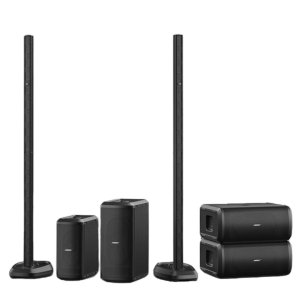
Bose L1 Pro portable PA system lineup — Pro8, Pro16 and Pro32

Warning for DJs using Tonematch T4s and T8s

Warning for DJs using Tonematch T4s and T8s

Warning for Djs using Bose ToneMatch T4s or T8s

First, a secondary or external mixer is in most cases highly recommended for DJs using all-in-one DJ mixer/controllers.  An external mixer means you have more headroom, perhaps better microphone preamps than what’s built into your DJ mixer, or more inputs if you only have a 2-channel DJ controller.

Why Bose L1 Pro DJs  Need a ToneMatch

While any external mixer is an advantage, the ToneMatch is a logical addition for DJs using the L1 Pro because of how it “talks” to the portable array system.

The L1 Pro delivers powerful, portable audio with a tiny footprint, but the ToneMatch mixer unlocks its full potential.  While live musicians/bands might find more use for the full suite of features packed into a T4s or T8s, there’s plenty for DJs to love when used properly with a DJ mixer or controller.

Precision-Tailored Audio with ToneMatch Processing:

The L1 Pro boasts impressive sound quality, but ToneMatch takes it a step further. This mixer utilises proprietary Bose digital signal processing (DSP) specifically calibrated for each L1 Pro model. This DSP meticulously fine-tunes the system’s response, ensuring pristine highs, clear mids, and deep, impactful bass.  The ToneMatch detects your system – Pro8, Pro16 or Pro32 and automatically applies the correct DSP settings.  Top 40 and EDM or the classic wedding hits, the ToneMatch guarantees it sounds right.

Streamlined Setup for Optimal Efficiency:

Gone are the days of wrestling with tangled cables.  Depending on your configuration, a ToneMatch T4s or T8s can connect seamlessly to your L1 Pro system with a single cable providing both power and audio. This not only simplifies setup but also saves valuable time before your performance. ToneMatch’s multiple inputs allow for simultaneous connection of your DJ controller, microphone, and even an additional music source, offering ultimate versatility for your setup.

Pro-Grade Sound Control at Your Fingertips:

ToneMatch empowers you with comprehensive sound sculpting capabilities. Built-in, high-quality EQs allow for precise tonal adjustments, enabling you to tailor the sound to your musical style and the venue’s acoustics.  You can even save “scenes” for some of those acoustically challenging venues – next time you’re there, just dial up the saved scene and everything willI be recalled from your last visit.

Best ToneMatch settings for DJs?

Here’s the warning part.  Most advice in online groups is to connect your DJ controller or mixer to the AUX inputs on your ToneMatch.  On the T4s this is channels 5 and 6, on the T8s it’s channels 9 and 10.  While these channels will work and will give you some headroom while allowing for additional input sources (mics, band instruments, etc) on the main channels, the AUX inputs have none of the ToneMatch magic.  No EQ, no high-level/low-level music presets, no “DJ” preset.  The AUX inputs are pass-through connections and bypass almost every ToneMatch setting.

Some even suggest a ToneMatch is a total waste of money for DJs if they’re mostly using channel 5/6 (T4s) or 9/10 (T8s).  You’re getting none of what makes the ToneMatch special!

My advice?  Either use two of the main inputs (ch 1 and 2) or set your DJ controller to mono and run your DJ master out into channel 1 on your ToneMatch.  This still leaves you three spare faders on the T4s, or seven spares on the T8s.

By running your DJ controller into the main ToneMatch inputs, you’re taking full advantage of the ToneMatch EQ and presets including the DJ mode built into the ToneMatch settings.

Set the channel gains and pan if required and then use the master or the DJ controller to adjust your overall volume as and when needed.

The Bose Effect: “win by association”

The Bose Effect: “win by association”

Articles

Here's something that you won't see on any official Bose website.​

Bose markets their name carefully and as a result "Bose" is a recognised brand.  They make home audio like sound bars, home theatre, noise cancelling headphones and earbuds, and back in the day they had that amazing sounding clock radio - among other things.

How does this help you?

Bose is recognised as a quality audio label. The Bose Effect.  You didn't have to do anything, Bose did all the work for you already and you win just by association.

I was setting up at a wedding venue with an original Bose L1 Model 1 many years ago. One of the staff saw the unusual looking "stick" and came for a closer look.  Upon seeing the little brand badge, he said "Oh.  It's Bose!  They always sound good.".... and then after a little pause he added "You must be a good dj!".  Their words not mine, and I'll take it.  This was before I'd even put any music on!

Nick Logan - Auckland-based wedding + corporate event DJ

That quote sums it up.  Bose has already done the marketing so everyday non-audio folks know their brand is good and can be trusted, and it doesn't matter if your audience knows anything about sound or not.

Would the average or majority of an audience at a wedding or corporate event recognise other pro audio labels such as Rane, EV, Yorkville, QSC, HK, or Mackie?  Even if they have heard of the brand, perhaps a more household name like JBL or Pioneer, only Bose has years of marketing history telling the world how amazing the brand sounds, how quiet the noise cancelling headphones are, how crisp and clear the home audio is, and so on.

If "beauty is in the eye of the beholder", then the quality of the Bose home audio range really comes down the ear of the beholder.  Even if someone tried to argue that better-sounding PA systems exist other than the Bose L1, there are none with a brand name as broadly recognised as the Bose name.

Clothing and shoe labels, alcohol and beverage manufacturers, and even other electronic companies pay billions to associate their brands with celebrities and sports stars.  Rugby games improve because of the boots, nightlife is more fun because of the clothing, and even a teeny tiny hangover is worth it because the guy from that Hollywood or those rap videos drinks the same bottle. Similarly, The Bose Effect is real.  Bose has done the marketing, and Bose has the brand recognition.  Why not use that to your advantage?

And of course, it's not just the brand.  The Bose Pro systems are lightweight, easy to transport and store, easy to set up and sound great.  And - guests assume you're a better entertainer.  Isn't that the goal?


Experience the unofficial Bose Effect with your official Bose Pro audio.  Call or email, tell me about your current setup up and see how we can help.

The Bose Effect win by association


Take a look at all of the Bose Professional audio options

Bose L1 Pro range

Bose S1 Pro


Bose F1 812 and Subwoofer